
Teeth whitening looks simple from the outside, but not every product works the same way, and not every option is right for every person. Some people get genuinely good results from a simple over-the-counter product, while others spend money on whitening that was never going to address their particular kind of discoloration. The difference usually comes down to understanding, before you buy anything, what is actually causing the color you want to change and what result is realistic for your teeth.
That is what this guide is for. In a city like Miami, where cosmetic dentistry is highly visible and patients often compare several practices, it helps to understand exactly what you are paying for and why. Below, we walk through the realistic whitening options from the drugstore shelf to the dental office, explain what each can and cannot do, look at what whitening tends to cost locally, and clarify the situations where bleaching is not the right tool at all. The goal is for you to find the one solution that genuinely fits your situation.
At D&FD, we usually recommend starting with an evaluation rather than starting with a product, because whitening works best when the plan matches the actual condition of your teeth. The key is not choosing the strongest option, but the right one.
A quick orientation before we begin, whitening lightens natural tooth. It does not change the color of crowns, veneers, or fillings, and it works differently depending on what is causing the discoloration. Knowing which kind of staining you have is the single most useful thing you can understand before spending money.
The honest hierarchy of whitening options, from drugstore to in-office
It helps to think of whitening options as a practical range rather than a list of good and bad choices. Each one has a place, and each one has limits. Nearly all of them rely on the same basic chemistry, using either just hydrogen peroxide or carbamide peroxide to break apart the pigment molecules that cause discoloration within the tooth. What separates them is mostly the concentration of the active ingredient, how long it stays in contact with the teeth, and whether the process is supervised by a professional.
In broad terms, drugstore products can help with mild surface staining, professional whitening done through a dentist tends to offer faster and more predictable results, and the right choice depends far more on your specific situation than on price alone. With that framing in mind, here is how the main options compare.
Over-the-counter strips and toothpastes: when they are enough
Over-the-counter whitening products, such as strips and whitening toothpastes, genuinely have their place. For mild surface staining from coffee, tea, wine, or ordinary daily habits, well-made strips can produce a noticeable improvement, and a reasonable body of clinical research supports their effectiveness when used as directed. They are an affordable, sensible starting point for someone who wants a modest change, has no significant sensitivity, and has no visible crowns, veneers, or bonding on their front teeth.
That said, these products do have real limits, and it is fair to be clear about them rather than overselling either side. Because strips are a standard shape rather than fitted to your teeth, coverage is often uneven, and the spaces between teeth and the back teeth tend to receive little contact. Results are therefore less predictable, and people with crowding or recession sometimes see patchy outcomes. Whitening toothpastes, for their part, work mostly by gently scrubbing away surface stains rather than changing the underlying color, so they help with maintenance but will not meaningfully lighten teeth on their own. A specific note of caution applies to all whitening toothpastes, specially the charcoal ones, which can be abrasive enough to wear down enamel over time without delivering genuine whitening, but instead, making the tooth yellower and weaker every time.
Not sure which type of stain you have? A dental exam can help clarify that before you spend money on whitening.
Custom take-home trays: a valid middle option
Sitting between drugstore products and in-office treatment is a third approach we offer directly at D&FD: professional take-home whitening using custom-fitted trays and a stronger gel than what’s available over the counter. Because the trays are molded from an impression of your own teeth, the gel sits evenly against the tooth surface rather than in a generic strip shape, giving more consistent coverage than drugstore strips can. Worn for a set period each day or overnight over one to two weeks, custom trays typically produce results comparable to our in-office treatment, just spread out gradually rather than compressed into a single visit.
It’s also the more affordable of our two professional options, priced below in-office Zoom whitening. For patients without a hard deadline who want a professionally supervised result without the cost of an in-office visit, this is usually the more sensible starting point.
In-office professional whitening: what you are actually paying for
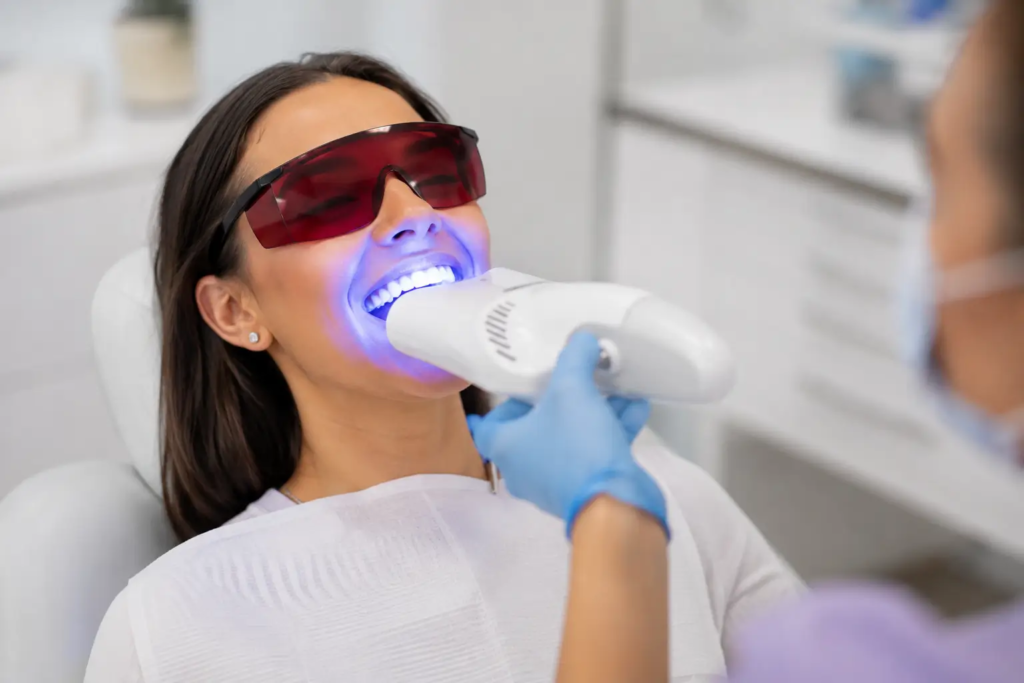
In-office whitening, performed by a dentist in a single visit, is the option that tends to deliver the fastest and most controlled results. What sets it apart is not simply a stronger product, but the level of control over every variable that affects the outcome, from start to finish. Understanding what actually happens during a session makes it much clearer why the experience and the result differ from anything you can do at home.
The process begins with the soft tissues being carefully isolated and protected. Because in-office gels are far more concentrated than home products, the gums, lips, and cheeks are shielded first, typically with a protective barrier applied along the gumline and a retractor that keeps the lips and cheeks away from the teeth. This single step, which is impossible to replicate at home, is one of the main reasons professional whitening can use a stronger agent safely. The higher concentration of peroxide is what allows meaningful color change in a single visit, and it is only appropriate because the surrounding tissues are protected from it. The activating light used with our Zoom system adds to that effect, but how much it adds depends heavily on the strength and proper calibration of the lamp itself; most of the whitening still comes from the peroxide concentration and the length of contact time, not the light alone.
From there, the dentist controls the application and the timing precisely. The gel is applied evenly across the teeth, left in place for a measured interval, then removed and often reapplied for one or more additional cycles within the same appointment. Because the whole process is monitored, the strength of the activating light, the number of cycles, and the total contact time can all be adjusted in real time according to how your teeth are responding, rather than following a fixed schedule printed on a box. If your teeth are responding quickly, the session can be eased back. If they are tolerating it well and more change is needed, the intensity can be increased within safe limits. That responsiveness is something no home product can offer.
This is also where the difference in result tends to show up. Because the gel is applied evenly and the teeth are treated as a whole under direct supervision, in-office whitening generally produces a more uniform change across the smile, including the areas that strips struggle to reach. The combination of a controlled environment, professional-strength materials, and a process that adapts to your teeth is what makes the outcome more predictable, rather than the gel alone.
It is worth being clear, then, about what the cost of in-office whitening genuinely reflects. You are not only paying for the whitening agent. You are paying for the protection of your soft tissues, for the controlled and adjustable application, for treatment that is supervised as it happens, and for a result shaped to your specific teeth in a single, efficient visit. In other words, you are paying for diagnosis, control, safety, and a more predictable process. That is the real value, and it is also why a supervised approach can reduce the risk of the uneven results or irritation that sometimes accompany whitening done without professional oversight.
For patients in Miami who want a faster, more predictable whitening plan, a consultation is usually the smartest first step.
What teeth whitening costs in Miami, and what insurance does and does not cover
Cost is understandably one of the first questions people ask, and it is also one where honesty matters most. Whitening prices in Miami vary considerably depending on the option you choose, the materials and system used, whether an evaluation is included, the number of sessions involved, and how much the treatment is personalized to your case. Rather than a single figure, it is more useful to think in terms of ranges and to understand what drives them.
Typical price ranges across Miami practices
To set realistic expectations, here are the price ranges you can generally expect in the Miami area, organized from least to most expensive. Keep in mind that these are typical market ranges rather than fixed figures, and your actual cost depends on your specific case.
Over-the-counter whitening kits and strips from the drugstore typically run from around $20 to $60, with whitening toothpastes costing even less. They are by far the most affordable option, which makes them a reasonable starting point for mild surface staining and a modest goal.
Professional take-home whitening, where a practice offers it with stronger gel than over-the-counter products, generally falls somewhere in the $100 to $400 range, reflecting the customized materials and professional oversight involved.
In-office professional whitening, the kind done in a single supervised visit, is the most significant of the three. In Miami, in-office treatment such as Zoom typically ranges between roughly $300 and $1,000, with many practices landing in the $350 to $600 range per session and premium or advanced systems reaching the higher end. A typical session involves three to four short applications of gel within the same appointment, which is part of what that price reflects. Combination approaches, where an in-office session is paired with take-home maintenance, sit at the upper end of the scale.
The important point is that no single tier is automatically the right one. A more affordable option makes sense for mild surface staining and a modest goal, while a professional approach makes more sense when you want faster, more predictable results, or when sensitivity, restorations, or deeper staining are part of the picture. Prices also vary meaningfully from one practice to another based on the system used, the expertise of the provider, and how personalized the treatment is, so the most reliable way to know what your specific situation will cost is to confirm it during an evaluation.
An evaluation gives you an accurate figure for your specific case, and just as importantly, it confirms that whitening is the right way to spend that money in the first place.
Why insurance does not cover whitening, and how to think about the investment
It is worth stating plainly that teeth whitening is considered a cosmetic procedure, and for that reason dental insurance typically does not cover it. Insurance is generally designed to cover treatment that addresses oral health and function, and because whitening changes appearance rather than health, it usually falls outside that scope. A small number of plans include cosmetic options, but this is the exception rather than the rule, so it is sensible not to count on coverage.
Since you are paying out of pocket regardless of the option you choose, it helps to think about value rather than simply the lowest price. The cheapest choice is not the best value if it does not work for your particular case, because you may end up spending again on something that does. This is precisely where an evaluation can save you money, by identifying what is actually causing your discoloration and whether whitening is the right solution at all, it helps ensure that whatever you spend is spent on something likely to work.
When whitening will not fix your problem, and what will
One of the most useful things a dentist can tell you is when whitening is not the right tool for what you want to achieve. This is not a negative message but a practical one, because understanding the limits of bleaching helps you avoid spending money on a result it cannot deliver. Whitening can brighten natural enamel and address external staining or natural yellowing very effectively. There are, however, several situations where it will not produce the change people are hoping for, and recognizing them in advance matters.
Whitening does not work on crowns, veneers, or fillings
This is one of the most common sources of confusion, so it is worth being clear. Whitening agents only lighten natural tooth structure. They have no effect on the materials used in dental restorations, which means crowns, porcelain veneers, composite bonding, and fillings keep their existing shade no matter how much whitening gel is applied. For anyone with visible restorations on their front teeth, this is an important planning consideration rather than a reason for concern.
People often ask several versions of the same question here. Can I whiten teeth that have crowns? You can whiten the natural teeth around them, but the crowns themselves will not change color, which can leave them looking darker by comparison. Will whitening change my fillings? It will not, for the same reason. Should I whiten before replacing a crown? Generally yes, because the standard sequence is to whiten the natural teeth first, let the shade settle, and then match a new restoration to your brighter result. Doing it in the other order can leave a mismatch that is costly to correct. That does not mean you have no options. It simply means your dentist should evaluate your full smile before you start.
If you have crowns, veneers, or fillings, ask your dentist before starting any whitening product.
Intrinsic stains need a different approach
Not all discoloration sits on the surface of the tooth. Dentists distinguish between extrinsic staining, which sits on the outer enamel and comes from food, drink, and habits, and intrinsic staining, which originates within the deeper structure of the tooth. Whitening tends to work well on extrinsic staining. Intrinsic discoloration is more variable, and in some cases it responds only partially to bleaching, or not in the way the patient expects.
Several things can cause intrinsic discoloration, including certain medications taken during tooth development, excessive fluoride exposure as the teeth formed, changes following trauma to a tooth, and the natural thinning of enamel with age that reveals the more yellow dentin beneath. Because these causes behave differently, intrinsic staining usually calls for a more personalized assessment. In some situations whitening can help to a degree, while in others a different cosmetic approach is more effective. The honest answer is that it depends on the individual tooth, which is exactly why an evaluation is valuable before committing to a plan.
When veneers may be the right answer instead of bleaching
Veneers are not the first answer for everyone, and we would never present them as a default upgrade. Consistent with our conservative philosophy, the more conservative option of whitening is usually the better place to start when it can achieve the goal. There are, however, specific situations where veneers may be the right answer because whitening cannot address the full cosmetic concern on its own.
Those situations tend to share certain features. Veneers may make sense when the color does not respond to whitening, when there is also a concern with the shape, size, or wear of the teeth in addition to color, when there is deep staining or visible restorations involved, or when someone is seeking a more complete change rather than simply a lighter shade. In other words, veneers are worth considering when the goal goes beyond what bleaching can do. When the goal is genuinely just a brighter version of your natural teeth, whitening is usually the more sensible and more conservative path, and an honest dentist will tell you so.
Sensitivity, gum irritation, and how to whiten safely
Whitening is generally safe for most people, particularly when the approach is matched to the condition of their teeth. It is not entirely without side effects, though, and understanding them is part of whitening safely rather than a reason to avoid it. The two most common are temporary tooth sensitivity and mild gum irritation, and both are usually manageable, especially when the process is supervised or adjusted to your situation.
Why teeth get sensitive during whitening, and how to manage it
During whitening, the active ingredients can temporarily affect how the tooth responds to temperature and air, which is why some people notice a brief sensitivity to cold during or shortly after treatment. For most people this is temporary and settles on its own within a day or two, and it does not signal lasting harm. That said, the experience varies, and someone with pre-existing sensitivity may need a slower or modified approach rather than a one-size-fits-all protocol.
Sensitivity is also worth paying attention to rather than simply pushing through, because in some cases it can be related to underlying factors such as enamel wear, gum recession, exposed roots, or even an undiagnosed cavity, as well as to the concentration of the whitening gel or overuse of a product. This is one of the clearest reasons that a brief evaluation before whitening is genuinely useful. A dentist can identify these factors in advance and adjust the concentration, frequency, or method accordingly, so that whitening is comfortable rather than something to endure.
Why a cleaning before whitening helps your result
There is a practical reason that a professional cleaning is often recommended before whitening, and it directly affects how well the treatment works. Plaque, tartar, and accumulated surface film sit between the whitening agent and the enamel. When that layer is removed first, the whitening can reach the tooth surface evenly, which tends to produce a more uniform and more predictable result.
A cleaning is therefore not just an extra step or an added cost. It helps your dentist see what whitening can actually improve, by revealing the true underlying color of the teeth, and it allows any issues such as decay or gum problems to be identified before whitening begins. Whitening over an undiagnosed problem can cause discomfort or aggravate it, so addressing the basics first is simply part of whitening responsibly. Seen this way, the cleaning improves both the safety and the quality of the result.
What we recommend at D&FD, and why your evaluation comes first
If there is one idea that runs through everything above, it is that the right whitening approach depends on your individual situation. That is why, at D&FD, we do not start by selling a whitening option. We start by evaluating your teeth, your restorations, your sensitivity level, your gum health, and your goals, and only then do we talk about which approach makes sense. This is not a sales step. It is what allows the recommendation to actually fit you.
Why a clinical exam before whitening can save you money
A short evaluation protects you from the most common and most expensive whitening mistakes. It identifies what is actually causing your discoloration, so that you do not spend money on a product that was never going to address it. It reveals whether a cleaning is needed first to get an even result. It flags whether crowns, veneers, or fillings on your visible teeth will affect the outcome and need to be planned around. And it helps you choose sensibly among the options, whether that is an over-the-counter product, a professional approach, or a different cosmetic solution altogether.
In short, the safest and most cost-effective whitening plan starts with understanding what is actually causing the discoloration. That is the part most people skip, and it is the part that most often leads to wasted spending and disappointing results. An evaluation is simply the step that makes sure whatever you do next is the right thing for your teeth, done in the right order, with realistic expectations from the start. It reflects the same transparent, no-pressure approach we bring to every part of our care across both of our Miami locations.
Schedule a whitening evaluation in Miami to find out which option actually makes sense for your smile. You can book at Gables Dental Care in Coral Gables or EliteDent in Kendall, and we will assess your teeth, explain your options honestly, and give you transparent pricing before you decide on anything.A brighter smile is one of the most accessible cosmetic improvements in dentistry, and for most people it is well within reach. The key is matching the method to your teeth and your goals rather than to the loudest marketing, and that is the conversation we are always glad to have with you first.