If you’ve been researching dental implants in the Coral Gables area, you’ve probably noticed that pricing is everywhere, from $999 to $5,000 or more for a single tooth, with little explanation of what makes the difference. That range isn’t an accident. It reflects genuine variation in what’s included, who’s placing the implant, and what the actual clinical situation requires.
This article gives you an honest breakdown of what dental implants cost in Coral Gables, what that price actually covers, and what questions to ask any practice before you commit to treatment.
At D&FD Miami, you receive a clear, itemized treatment plan with transparent pricing before anything begins, no surprise costs, no pressure. Your initial evaluation is $250 and includes examination and 3D X-rays.
The honest price range for dental implants in Coral Gables
Dental implant pricing in Coral Gables and the broader Miami-Dade area follows a fairly consistent market pattern, with meaningful variation depending on case complexity and the type of restoration involved. Here’s what you can realistically expect.
Single tooth implant cost in Miami-Dade
For a straightforward single-tooth implant, meaning adequate bone is present, gum health is good, and no additional procedures are required before placement, the total cost in Coral Gables typically falls between $2,800 and $5,000. This covers all three components of a complete implant restoration.
Practices advertising significantly lower prices for a single implant (in the $999–$1,789 range) are typically quoting only part of the restoration. Always ask whether the quoted price includes the implant post, the abutment, and the crown together, or just one component.
All-on-4 or full arch implant cost
All-on-4 is a full-arch restoration technique where four implants support a complete set of teeth for an entire jaw. It’s designed for patients who have lost most or all of their teeth on the upper or lower arch, or whose remaining teeth cannot be saved.
In Coral Gables and Kendall market, all-on-4 pricing typically ranges from $18,000 to $30,000 per arch, depending on whether bone grafting is needed, the materials used for the final prosthesis, and the number of pre-implant extractions required. Full-mouth rehabilitation (both arches) can range from $35,000 to $60,000 or more at full market rates. Financing options can significantly reduce the monthly impact of that investment. We work with financing partners offering genuinely useful payment plans, several of which include up to 24 months with no interest, so a larger treatment plan can be spread out rather than paid all at once.
If All-on-4 is being considered, the evaluation is even more important than for a single-tooth case, the treatment involves more variables, more appointments, and a longer timeline.
What’s included, and what usually isn’t
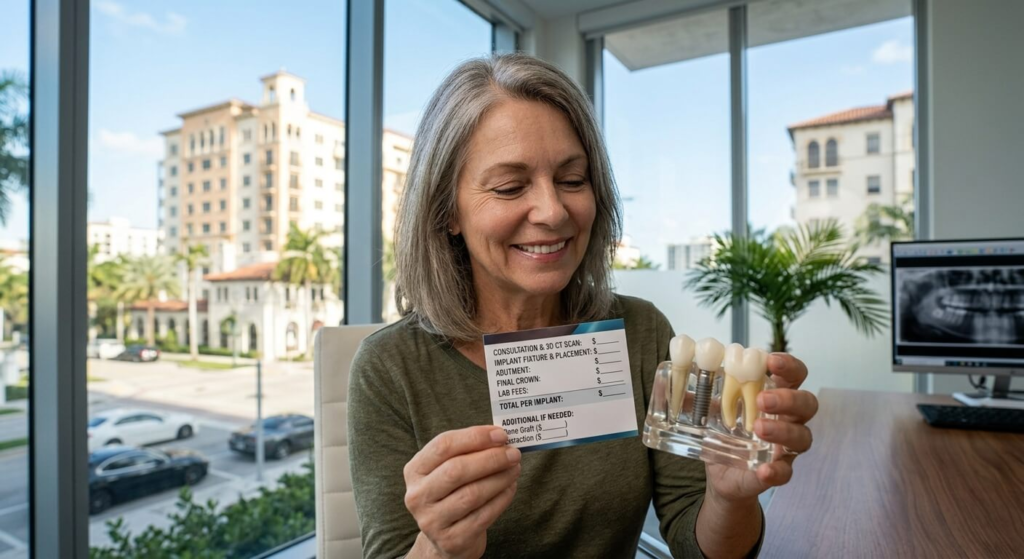
A complete single-tooth implant restoration consists of three separate components, each of which may be billed separately depending on the practice:
- The implant post: the titanium screwlike post surgically placed into the jawbone. This is what integrates with the bone over the healing period (osseointegration).
- The abutment: a small connector piece that attaches to the top of the implant post and provides the foundation for the crown. It may be a generic standard piece or a custom made for your specific case needs.
- The crown: the visible, tooth-shaped cap that is attached to the abutment and matches the color and shape of your surrounding teeth.
When a practice advertises a price like $1,789 per implant, that figure often includes only the implant post, the surgical component. The abutment and crown are typically billed additionally, which can add $800 to $1,800 to the total. Some quotes include the implant and abutment but not the crown. Others may include all three.
Before agreeing to any implant treatment, ask for a written breakdown of every component included in the quoted price and what any additional procedures (bone graft, extraction, sinus lift) would cost if needed.
At D&FD, your treatment plan itemizes every component and every associated procedure before treatment begins. The price you see is the price you pay.
Why dental implant prices vary so much in Miami
The $4,000 range between the low and high ends of the single-implant market isn’t arbitrary. Several legitimate variables drive that spread.
The implant post, the abutment, and the crown, three separate costs
As described above, an implant is not a single product. Each of the three components, post, abutment, crown, carries its own material cost and its own laboratory or fabrication cost. The crown alone, if fabricated from high-quality ceramic by a skilled dental lab, can cost $800 to $1,500 on its own. When a practice charges $999 for the entire implant, something in that chain is compromised.
Does bone grafting affect my total implant cost?
Yes, significantly. Bone grafting is required when the jawbone at the implant site lacks sufficient volume or density to support the post. This is common when a tooth has been missing for a year or more, when bone was lost due to infection, or when a tooth was extracted without planning for an implant.
A localized bone graft (socket preservation or a small augmentation) typically adds $300 to $800 to the total cost. A more significant graft, such as a block graft to rebuild a larger area, can add $1,500 to $3,000 or more, plus it extends the timeline by several months while the graft heals before implant placement can proceed.
Not every patient needs a bone graft. Imaging at your evaluation will determine whether grafting is necessary and, if so, what type and scale is appropriate.
How experience, technology, and materials affect the price
Three additional variables explain a meaningful portion of price variation across practices:
- Implant brand and material quality: implant systems vary in their track record, surface technology, and long-term integration outcomes. Premium implant brands have higher material costs than no-name alternatives. The difference in long-term survival rates is clinically significant.
- Technology: practices using 3D CBCT imaging and digital planning tools have higher overhead but significantly better accuracy in implant placement, which reduces complications. Guided implant surgery, where placement is precisely mapped before the procedure, costs more to perform but delivers more predictable outcomes.
- Dentist training and experience: placing implants is a surgical skill. Dentists who have completed advanced implant training or who place a high volume of implants each year have both the knowledge and the clinical efficiency that contribute to better outcomes.
At D&FD, our doctors bring both advanced clinical training and the technology infrastructure needed for precise, predictable implant treatment. Our pricing reflects that, and it’s always explained in full before you decide to move forward.
How D&FD approaches implant pricing at Gables Dental Care
We’ve deliberately built our practice around the problems that drive patients away from dentistry. Hidden costs and feeling pressured into treatment are the two most common reasons people delay care they know they need. Our implant pricing process is designed to eliminate both of those barriers.
Transparent treatment plan before anything begins
Before any procedure is scheduled, you receive a written treatment plan that itemizes every component of the proposed treatment and its associated cost. This includes the implant, the abutment, the crown, any additional procedures that are indicated (bone graft, extraction, sinus lift), and the cost of the restoration phase.
Nothing is vague. Nothing is a “starting from” estimate. You see the full picture before committing to anything.
If your plan changes based on what we find during treatment, for example, if a bone graft turns out to be needed after a more detailed imaging assessment, we explain the change, give you the updated cost, and wait for your go-ahead before proceeding.
Your $250 evaluation: what it covers and how it works
Your first step at D&FD is a comprehensive evaluation for $250. This is not a cursory consultation, it’s a full diagnostic appointment that includes:
- A thorough examination of your teeth, gums, and bite
- Diagnostic 3D X-rays to assess bone levels and overall oral health
- A review of your medical history and medications
- A clear explanation of our findings and what we see
- A detailed treatment plan with transparent pricing
The evaluation is intentionally scheduled with ample time. You’re never rushed. You leave with a full understanding of your clinical situation and a clear set of options, and no obligation to proceed.
The $250 evaluation gives you exactly the information you need to make a good decision, without any pressure to act before you’re ready.
Financing options that make implants accessible
Dental implants are a meaningful investment. For most patients, the sticker price of a full restoration is the primary obstacle to moving forward, not the willingness to commit to treatment.
At D&FD, we work with multiple financing partners to offer payment plan options that distribute the cost of treatment into manageable monthly amounts, several of which include up to 24 months with no interest. Depending on your financial situation and the total treatment cost, options may include low- or no-interest financing for qualified applicants.
We also accept most major dental insurance plans. Call us before your visit and we’ll verify your coverage so you arrive knowing exactly what your plan contributes toward your evaluation and any subsequent treatment.
Cost shouldn’t be the reason care gets delayed. For patients without insurance, D&FD offers several in-house membership plans that give real flexibility, without the annual maximums, waiting periods, or network restrictions that come with traditional coverage.
Are dental implants worth the cost? What most patients say after treatment
The financial question is legitimate and worth asking directly. Dental implants are the most expensive tooth replacement option available. They are also, for most patients, the one that delivers the most durable, natural-feeling, and functionally complete result.
Implants vs. dentures: the real long-term cost comparison
A conventional full denture typically costs $1,500 to $3,500 per arch, significantly less than an implant-supported solution upfront. But dentures require replacement every five to ten years, may need periodic relining as the jawbone changes shape, often require adhesives for stability, and do nothing to prevent the ongoing bone loss that occurs when there’s no tooth root stimulating the jaw.
Over a 20-year period, the total cost of multiple denture replacements, adjustments, and related treatments often approaches or exceeds the cost of an implant-supported solution that, with proper care, can last a lifetime. The long-term cost comparison is closer than the initial price gap suggests.
For patients who are still weighing implants against dentures, we cover this in detail in a separate article. The short version: both are legitimate options depending on your situation, and our evaluation will help you understand which makes more clinical and financial sense for you specifically.
The hidden cost of not replacing a missing tooth
There’s a cost to waiting that most patients don’t factor into the decision. When a tooth is extracted and not replaced, the jawbone in that area begins to resorb, a process where bone volume is gradually lost because there’s no tooth root to stimulate it. This begins within the first few months and continues over years.
The consequences are both functional and aesthetic: adjacent teeth can drift into the gap and tilt, altering your bite; bone loss can affect the stability of neighboring teeth; and the facial profile in the area can gradually change as bone volume decreases.
From a treatment cost perspective, bone loss means that a patient who waits two or three years to replace a missing tooth may now require a bone graft that they wouldn’t have needed immediately after extraction. That’s an additional $500 to $3,000 that didn’t have to happen.
This isn’t meant to pressure anyone into a rushed decision. It’s information that should be part of how you weigh timing.
Does dental insurance cover implants in Florida?
This is one of the most common questions we hear, and the honest answer is: it depends on your specific plan. Florida has no statewide mandate requiring dental insurers to cover implants, which means coverage varies considerably across carriers and plan tiers.
What most PPO plans cover, and what they don’t
Most PPO dental plans in Florida treat implants as a major restorative procedure and apply a coinsurance formula, typically covering 50% of the allowed amount after the deductible, up to an annual maximum that usually falls between $1,000 and $2,000. In practice, that means most plans contribute $500 to $1,500 toward an implant restoration in a given benefit year.
A few higher-tier plans cover the crown or abutment separately as a prosthetic appliance, which can provide additional coverage. Plans that explicitly exclude implants are common in lower-cost employer plans, these will cover the extraction but not the replacement.
Important nuance: insurance companies have their own definition of what constitutes “implant-related” costs. A bone graft may or may not be covered depending on how your carrier classifies it. Verification before your appointment, not after, is essential.
How to verify your insurance before your visit at D&FD
Before your evaluation, call us and give us your insurance information. We’ll verify your coverage directly with your carrier and tell you:
- Whether your plan covers implants and at what percentage
- What your remaining annual maximum is for the benefit year
- Whether any waiting periods or frequency limitations apply
- What out-of-pocket costs to expect for the evaluation itself
You can also call the number on the back of your insurance card directly, ask specifically about CDT codes D6010 (implant body placement), D6057 (abutment), and D6058 (crown) or D6740/D6245 to get an accurate picture of what your plan covers for each component.
If you don’t have dental insurance, we’ll walk you through inhouse plans and financing options that can make treatment viable regardless.
Ready to get your personalized implant estimate in Coral Gables?
There’s no accurate answer to “how much will my implants cost” without a clinical examination and imaging. The variables that drive price, bone volume, gum health, the number of implants needed, the type of restoration, can only be assessed in person.
What we can guarantee is that you’ll know the full cost before anything is scheduled. Every procedure itemized. Every question answered. No surprises after the fact.
Book your evaluation at Gables Dental Care (3815 SW 8th Street, Coral Gables) or EliteDent (12538 SW 120th Street, Kendall). $250 includes your examination and X-rays. Call to verify insurance first if you’d like, we’re happy to check your coverage before your visit.
You move forward only when you’re ready, with a plan you understand, pricing you can count on, and a team that’s focused on your long-term results. That’s how we do things at D&FD.