If you’re weighing dental implants against dentures, you’ve probably already noticed that most articles on this topic are written by practices that clearly favor one option. The implant-heavy articles make dentures sound outdated and inferior. On the other hand, the denture-focused content makes implants sound unaffordable and overhyped.
The truth is that both are legitimate, well-established options, and for different patients, each can be the right choice. At D&FD Miami, we see patients across the full spectrum: some are strong implant candidates, some are better served by dentures, and many fall somewhere in between. This article gives you the honest comparison we’d give you in the office.
At D&FD, we don’t push you toward the more expensive option. An evaluation gives you a clear recommendation based on your clinical situation, not our revenue targets.
The core difference: what you’re actually choosing between
Before comparing the two options, it helps to be clear about what each one actually is. The difference isn’t just aesthetic, the underlying mechanism is completely different, which explains why the trade-offs land where they do.
What dental implants are and how they work
A dental implant is a titanium post that is surgically placed directly into the jawbone, where it functions as an artificial tooth root. Over a healing period of three to six months, the bone grows around and fuses with the post, a process called osseointegration. Once integration is complete, a custom-made crown is attached to the top of the post via a connector piece called an abutment.
The result is a restoration that is fixed in place, indistinguishable from a natural tooth in appearance and function, and rooted in the jaw the same way a natural tooth would be. Implants can replace a single tooth, multiple teeth, or support a full arch of teeth when used in combination (as in All-on-4 treatment).
For more detail on the implant process and what it costs, see our breakdown in the implants cost guide.
What dentures are, conventional, partial, and implant-supported
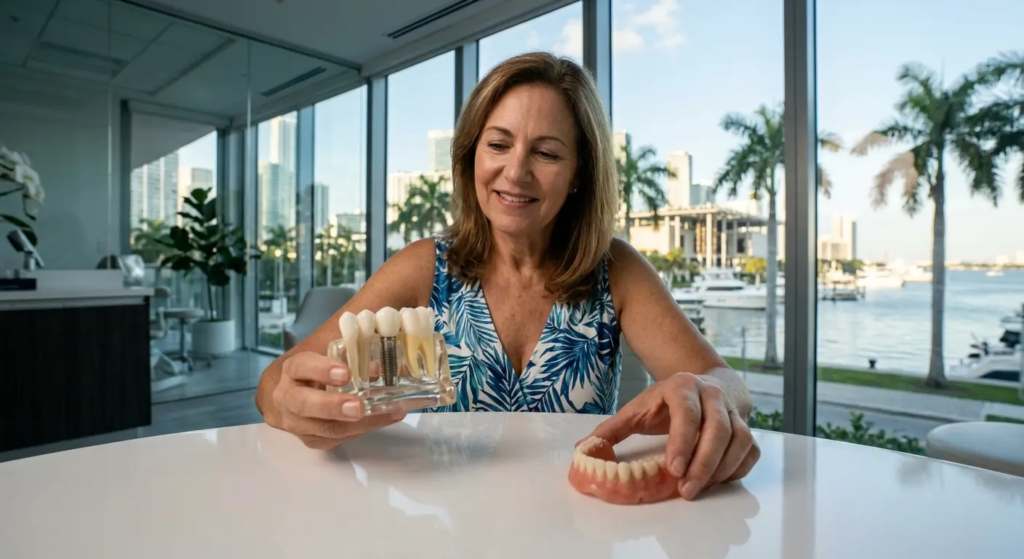
Dentures are prosthetic appliances that replace missing teeth and the surrounding gum tissue. They come in several forms, and understanding the differences matters for a fair comparison:
- Conventional full dentures: removable prostheses that replace an entire arch of teeth. They rest on the gum tissue and are held in place by suction and, often, denture adhesive.
- Partial dentures: removable appliances that replace several missing teeth while remaining natural teeth provide additional support. They clip onto remaining teeth with clasps.
- Implant-retained overdentures: removable dentures that snap onto two to four implants for stability. They offer significantly improved retention over conventional dentures while remaining removable for cleaning.
- Implant-supported fixed bridges, often called hybrid (All-on-4 / All-on-6 / All-on-X): full-arch restorations supported by four to six implants that are permanently fixed in place and function like natural teeth.
The last two categories sit in a hybrid territory between implants and dentures. When patients ask about ‘dentures vs. implants,’ they’re often not aware that implant-supported dentures exist as a middle option, and that changes the comparison considerably.
Comparing implants and dentures across five factors that actually matter
Here is where we put both options through the same honest lens, factor by factor.
Cost: upfront price vs. total lifetime cost
Dentures win on upfront cost, and there’s no point pretending otherwise. A conventional full denture typically costs $1,500 to $3,500 per arch, compared to $3,000 to $5,000 or more for a single dental implant. For full-arch implant solutions like All-on-4, the investment is $18,000 to $30,000 per arch.
However, the upfront comparison is only half the picture. Conventional dentures need to be replaced every five to ten years as the jawbone changes shape and therefore the fit degrades. They typically require periodic professional relining (adding material to restore fit), and many patients use adhesives daily. Over a 20-year period, the cumulative cost of multiple denture cycles, adjustments, adhesives, and related appointments often approaches or exceeds the cost of a well-maintained implant-supported solution.
Implants, by contrast, are designed to be permanent. With proper care and routine dental check-ups, the implant post can last a lifetime. The crown on top may need replacement after 15 to 20 years, but the underlying implant typically does not.
The honest summary: if upfront affordability is the primary constraint, dentures are a real and reasonable option. If you’re making a long-term investment and want to minimize total lifetime cost, implants often win over time.
Comfort and daily function: eating, speaking, and confidence
This is the factor that matters most to patients once they’re living with their chosen solution.
Dental implants feel like natural teeth. They’re fixed in place, require no adaptation period beyond the healing phase, and do not restrict what you eat. Patients report quickly forgetting they have implants at all, which is the highest possible endorsement of a dental restoration.
Conventional dentures require a real adjustment period. The muscles of your cheeks, lips, and tongue need time to adapt. Many patients initially experience difficulty with certain foods, some self-consciousness about movement when speaking or laughing, and the occasional awkward moment with adhesive. With time and a well-fitted denture, most patients adapt successfully and function well. But ‘well-fitted’ is not permanent, as the jaw changes, the fit changes, and periodic relining or replacement becomes necessary.
Implant-retained overdentures offer a meaningful middle ground: they snap securely onto implants and eliminate most of the retention problems of conventional dentures, while still being removable for cleaning.
Bone health: why this factor is almost never discussed
This is the factor that most comparison articles skip, and it may be the most clinically significant one on the list.
When a natural tooth is present, the tooth root stimulates the surrounding jawbone every time you bite or chew. That stimulation signals the bone to maintain its density and volume. When the tooth is lost and not replaced with a root-like structure, the jawbone begins to resorb, gradually losing volume over months and years.
Conventional dentures rest on the gum surface and provide no stimulation to the underlying bone. Over time, bone resorption continues under a denture, which is why dentures that fit well initially eventually become loose: the jaw is literally changing shape beneath them. The aesthetic consequence is the ‘sunken’ facial profile that becomes more pronounced over years of denture wear.
Dental implants are the only tooth replacement option that mimics the function of a natural tooth root. By integrating with the jawbone, implants provide the stimulation needed to prevent resorption and preserve bone volume. For patients who expect to have a gap in their jaw for years or decades, this is a factor worth weighing seriously.
At D&FD, our preservation-first philosophy means we always consider long-term bone health when recommending a treatment path, not just the short-term restoration.
Longevity and maintenance: what each option actually requires
With proper care, a dental implant can last 20 to 30 years or a lifetime. The titanium post is highly biocompatible and rarely fails once fully integrated. The porcelain crown on top is more susceptible to wear and may need replacement after 15 to 20 years, but the implant body beneath it typically does not.
Maintenance for implants mirrors the maintenance for natural teeth: brush and floss daily, attend regular professional check-ups, and avoid habits that damage teeth (grinding, chewing on hard objects). There are no special cleaning solutions, no overnight soaking, and no adhesives.
Conventional dentures require more involved daily care: removal at night, soaking in a denture solution, brushing with a soft denture brush, and avoiding certain foods that can damage or dislodge them. They also need professional relining every two to three years as the jaw changes, and full replacement every five to ten years. Partial dentures require careful cleaning around the clasps to prevent decay on the remaining teeth they rest against.
Implant-supported overdentures require both: implant hygiene around the posts, plus daily denture cleaning. They are more maintenance-intensive than either conventional dentures or fixed implants alone, but offer stability improvements that many patients find worth the tradeoff.
The procedure itself: what to expect for each treatment path
Understanding the timeline and what each process involves reduces the anxiety that often delays necessary treatment.
For dental implants, the process unfolds over several months. The timeline depends on whether bone grafting is needed and how many teeth are being replaced, but a straightforward single-tooth implant typically follows this sequence: evaluation and imaging, implant placement surgery (under local anesthesia, usually 45 to 90 minutes), a healing period of three to six months while osseointegration occurs, then crown placement. Most patients report that the implant surgery itself is easier than they expected, with manageable post-operative discomfort controlled by over-the-counter pain medication in most cases.
For conventional dentures, the process is shorter. Remaining teeth that can’t be saved are extracted, any necessary healing time elapses, impressions are taken, the denture is fabricated, and fitting appointments follow to refine the fit. Total timeline is typically two to three months for a conventional denture. The adjustment period afterward, getting used to the feel and function of the prosthesis, varies considerably between patients, from a few weeks to several months.
For implant-retained dentures, the timeline is longer because it combines implant surgery with denture fabrication, but the functional result is substantially better than a conventional denture alone.
Who is each option actually right for?
The comparison above sets out the factors. Here’s how those factors translate into real patient profiles.
When implants are the stronger clinical choice
Dental implants tend to be the stronger long-term option for patients who:
- Are missing one, two, or a few teeth and want a permanent, fixed restoration that doesn’t involve altering adjacent healthy teeth
- Are younger adults or middle-aged patients with decades ahead of them who would otherwise face multiple denture replacements over their lifetime
- Have adequate bone density and healthy gums, or are willing to address those factors with preliminary treatment
- Value the closest possible functional equivalent to natural teeth, in terms of chewing ability, feel, and not having to think about their teeth
- Are concerned about long-term jaw bone preservation and want to prevent the facial profile changes that come with bone resorption
If you’re unsure whether you qualify for implants, our dedicated article on candidacy walks through the clinical factors in detail.
When dentures are a reasonable and valid choice
We want to be clear about this: dentures are not a second-rate option. For the right patient, they are a cost-effective, well-established, and functionally sound solution. Dentures tend to be the appropriate path for patients who:
- Have significant bone loss that would require extensive grafting before implant placement, particularly if the scope of that grafting is disproportionate to the patient’s overall health or timeline
- Have systemic conditions (severe uncontrolled diabetes, certain autoimmune conditions, or other health factors) that significantly complicate surgical procedures
- Are on a tight budget and need a functional solution now, with the understanding that total long-term cost may be higher
- Are elderly patients for whom the implant surgery timeline and recovery is not the right trade-off given their health situation and life circumstances
- Are replacing a full arch and prefer a non-surgical solution, particularly when implant-supported overdentures are not being considered
If you’re in this category, we’ll tell you so directly. Recommending a less expensive treatment when it’s the right one is how we build the kind of patient relationships that last decades.
Can you switch from dentures to implants later?
Yes, in most cases, patients who currently wear dentures can transition to an implant-supported solution later. This is a question we hear often, and the answer matters because it removes the fear that choosing dentures now permanently closes the implant door.
The main variable is bone. Every year that passes with a conventional denture in place allows the underlying jawbone to continue resorbing. The longer a patient wears conventional dentures, the more likely it becomes that bone grafting will be required before implant placement is possible. Bone grafting adds time and cost, but for most patients it remains a viable path.
The most common transition we see is from conventional dentures to implant-supported overdentures: two to four implants are placed, and the existing denture is modified to snap onto them. This gives patients the stability they were missing without requiring a full implant reconstruction.
If you’re currently wearing dentures and want to explore whether implant support is an option for you, a clinical evaluation is the place to start. Imaging will tell us what the current bone situation looks like and what would be required.
What D&FD recommends, and how we help you decide
At the end of a comparison article like this, most patients want someone to just tell them which one to choose. We understand that impulse, and we want to give you a clear answer, which is exactly why we won’t give you a generic one.
Why we won’t tell you which is better without seeing you first
The factors that determine which option is right for you, your bone density, your gum health, your systemic health, how many teeth are missing and for how long, your bite, your budget, your timeline, can’t be assessed from a website form or a phone call. They require a clinical examination and imaging.
What we can tell you is that the recommendation you’ll receive at D&FD is based on your clinical picture, not on which option generates more revenue for the practice. If dentures are the better path for you, that’s what we’ll recommend. If implants are clearly the better long-term investment for your situation, we’ll explain why in plain language so you can make an informed decision.
Patients regularly come to us for second opinions after being told by another practice that they need aggressive implant treatment. Sometimes the original recommendation was right. Sometimes we find a more conservative, less expensive path that serves the patient just as well. We’ll give you our honest assessment either way.
Your $95 evaluation: the clearest next step
If you’ve read this far, you’re ready to move from research to a real answer. The $95 evaluation at D&FD includes an examination and diagnostic X-rays, reviewed by one of our doctors who will walk you through exactly what they see and what they’d recommend for your situation.
You’ll leave with a clear treatment plan and transparent pricing for whichever path makes sense for you. There’s no obligation to proceed during the visit, and no pressure afterward. You move forward when you’re ready.
Book your evaluation at Gables Dental Care (3815 SW 8th Street, Coral Gables) or EliteDent (12538 SW 120th Street, Kendall). Call to verify insurance before your visit and we’ll confirm your coverage in advance.
The best tooth replacement option is the one that fits your clinical situation, your timeline, and your life. That’s what we’ll figure out together.